


Why Forgetting Can Make Firearms Training More Effective
What to Know
- Forgetting is not inherently a sign of intelligence, but research suggests a healthy memory system benefits from selectively reducing irrelevant information so people can make better decisions and adapt to changing situations.
- In firearms and law enforcement training, effective performance depends not on remembering every detail, but on retrieving the right information, recognizing relevant cues and selecting the appropriate response under pressure.
- Firearms training should strengthen useful behaviors while reducing the influence of outdated or context-specific responses through spacing, interleaving, variability and realistic decision-making exercises.
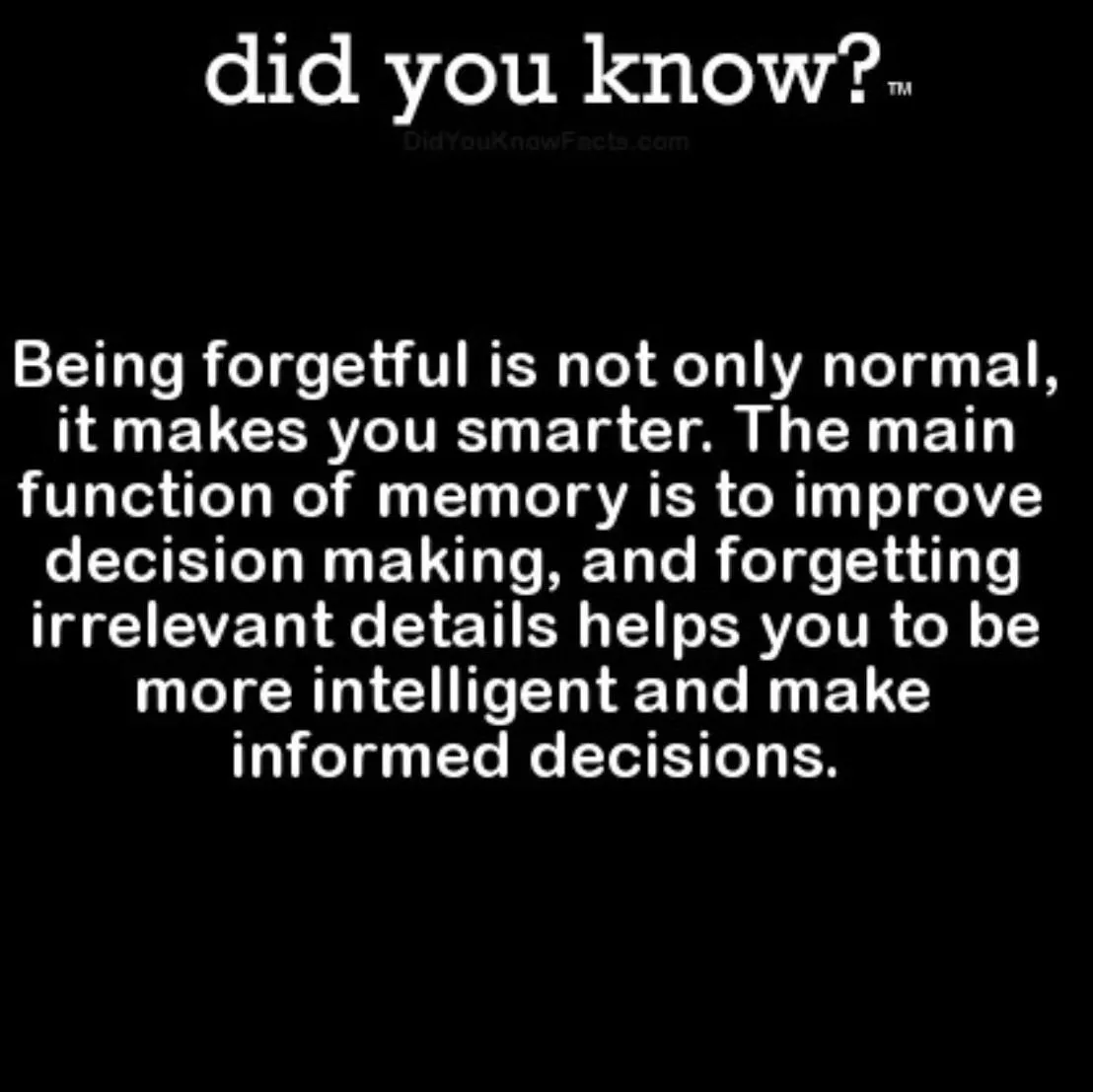
The meme shown to the right is one that I’ve seen circulating on several of my social media feeds for about a year or two now, and it intrigued me because of the provocative claim that it makes: Being forgetful is not only normal, it makes you smarter.
It further suggests that memory exists primarily to improve decision-making and that forgetting irrelevant details helps people make better, more informed choices.
Like most viral neuroscience, the statement contains a meaningful idea wrapped inside an overstatement. Forgetfulness does not automatically make anyone smarter. Memory loss caused by sleep deprivation, distraction, traumatic brain injury, neurological disease, intoxication, chronic stress or inadequate learning is not beneficial. An officer who forgets the legal standard governing the use of deadly force is not demonstrating cognitive efficiency. A student who cannot remember the foundational safety rules of firearms handling has not achieved some higher form of intelligence.
There is, however, a scientifically defensible principle beneath the social media language. A healthy memory system is not designed to preserve a complete and permanent record of everything we experience. It must retain information that remains useful, reduce the accessibility of information that has become irrelevant and help us extract general patterns that can guide future behavior. In that sense, forgetting is not always evidence that memory has failed. Sometimes it is evidence that memory is doing exactly what it was designed to do.
When Forgetting Helps Rather Than Hurts
Blake Richards and Paul Frankland offered one of the clearest scientific explanations of this idea in their 2017 paper, “The Persistence and Transience of Memory.” They argued that intelligent memory depends on a balance between persistence and transience. Persistence allows important information to remain available. Transience reduces the influence of outdated or excessively specific information. Together, these processes may support flexible decision-making in noisy, changing environments. Forgetting can prevent us from becoming cognitively overfitted to the past, meaning so tightly bound to the details of previous experiences that we cannot adapt when the present situation differs from them (Richards & Frankland, 2017).
That concept should command the attention of anyone responsible for firearms instruction. The objective of high-liability training is not to create a student who remembers every target, every command, every sequence and every correction ever encountered on a range. The objective is to develop a student who can retrieve the right information, recognize the right cues and execute the right behavior when conditions are uncertain, unfamiliar and consequential.
Memory is therefore not simply a warehouse. It is part of an adaptive control system.
When I watch an experienced shooter perform, especially in high-fidelity simulation trainings, I am not merely seeing someone who has stored more information than the novice standing beside him. I am often seeing someone who has become better at filtering information. The experienced performer notices the cues that matter and ignores much of what does not. He does not consciously inventory every sensation associated with grip pressure, visual alignment, posture, recoil and trigger movement. Many of those processes have been compressed into organized motor and perceptual structures that require less conscious management.
This does not mean the information has disappeared. It means the brain no longer treats every component as equally deserving of attention.
That distinction is important because firearms instructors often speak about memory as though learning were accomplished entirely by strengthening a desired response. We repeat a movement, reinforce it with feedback and assume that sufficient repetition will eventually make it permanent. There is truth in that explanation, but it is incomplete. Skilled performance also requires the nervous system to manage competition among memories, actions and interpretations.
The shooter may know several ways to solve a problem. The officer may have encountered multiple versions of a similar event. The instructor may have taught different techniques at different points in a student’s development. During performance, these possibilities do not politely wait in separate mental folders. They may compete for retrieval and response selection. The brain must promote what is useful while reducing the disruptive influence of what is not.
Retrieval-Induced Forgetting and Competing Memories
Michael Anderson, Robert Bjork and Elizabeth Bjork demonstrated this phenomenon in a series of experiments published in 1994. Participants learned category and word pairings and then repeatedly retrieved only some of the learned items. Retrieval strengthened the practiced information, as expected. More surprisingly, it impaired later recall of related information that had not been practiced. Remembering some information had caused related information to become less accessible, a process now known as retrieval-induced forgetting (Anderson et al., 1994).
This does not necessarily mean that the competing memories were deleted. In many cases, forgetting reflects diminished accessibility rather than total loss. The information may remain stored while becoming harder to retrieve under a particular cue. That is a far more useful way to understand forgetting in the firearms context. We should be extremely cautious about saying that training can erase an old motor program. The human literature does not support such a simple claim. Old responses may remain available and can sometimes reappear after time, stress, contextual change or renewed exposure.
What training can do is repeatedly strengthen the retrieval of a more appropriate response while reducing the probability that a competing response will dominate under the same conditions.
When Training Creates the Wrong Associations
Imagine an officer whose firearms experience has been shaped almost entirely by predictable qualification courses. A command is given. A target is already visible. The officer knows in advance that shooting will be required. The task is not truly whether to shoot. The task is to execute a known string of fire with acceptable accuracy.
After years of this structure, the officer may become very efficient at responding to a command and a visible target. That efficiency may look like expertise, but the learned relationship is narrow. The cue initiates the gunfire sequence because the training environment has made the cue nearly perfectly predictive.
Now place that officer in a more realistic exercise. A person appears suddenly. The hands are initially obscured. The object being held is ambiguous. The person may comply, turn away, drop the object, move toward another person or produce something that only briefly resembles a weapon. The relevant task is no longer merely executing a shooting technique. It is identifying, interpreting, predicting and selecting.
The strongest memory must not simply be “target appears, gun fires.” The more useful relationship is conditional: observe, discriminate, decide and then apply the appropriate response. If qualification culture has overstrengthened an anticipatory shooting pattern, later training must create enough decision conflict to make the old pattern less dominant and the conditional pattern more accessible.
This is where forgetting becomes operationally important. The officer does not need to forget how to fire accurately. He may need to reduce the automatic influence of irrelevant range cues that have become incorrectly attached to the act of firing. He must retain the mechanics while becoming less governed by the artificial context in which those mechanics were originally rehearsed.


